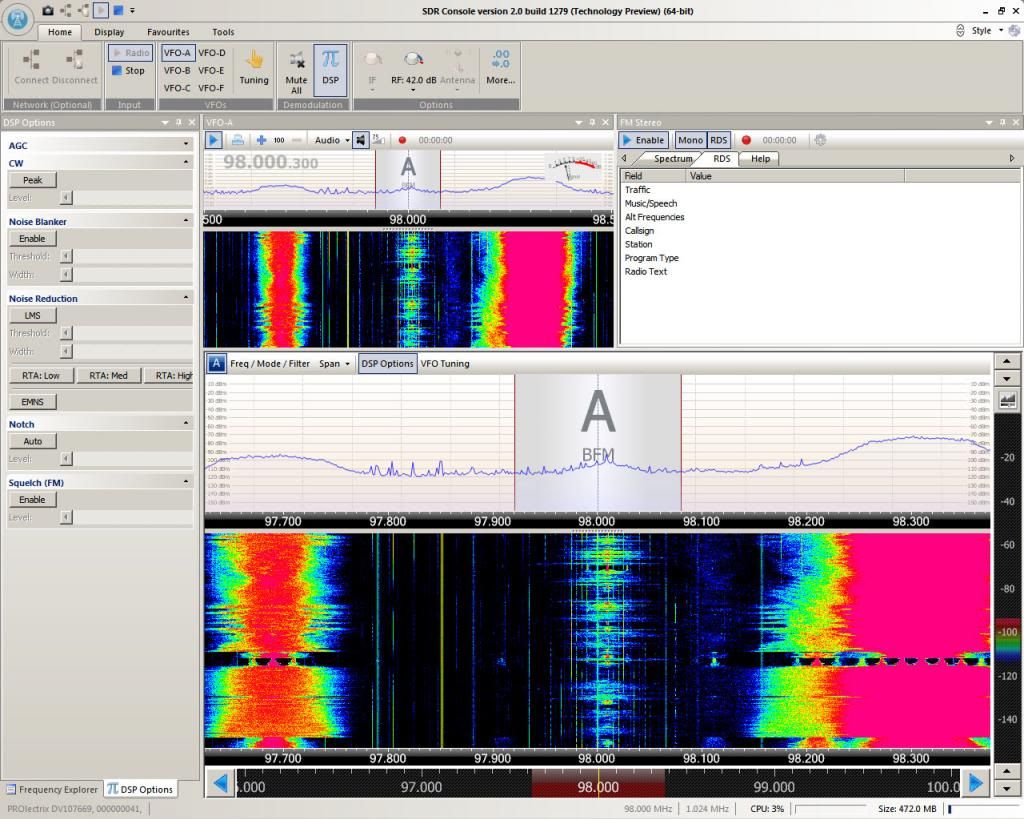
Don't install the software which comes with this USB dongle if you want to get the best band 2 performance. Instead, try using something like SDR Radio or SDR# as these offer much more control than the bundled software. Both of these are free and each have their own advantages. Personally, I like the SDR Radio software as, although rather complicated at first sight, does a lot, lot more.
My interest in these dongles was aroused a couple of weeks ago when I read that they can be used as SDRs (Software Defined Radios) on the the VHF band 2 FM broadcast spectrum, allowing up to 2 MHz of recording bandwidth. I wasn't convinced, initially, until I read some reports on the Skywaves FM Forum stating just how good they actually were. I was advised to get one to have a play, so I did.
To begin with, the installation of the software isn't exactly straight-forward, though there is a lot of help documented on various websites and forums, such as the SDR Radio Forum and the SDR Radio website. It took me a good few hours to work out how to complete the installation as the appropriate drivers were not initially found by the software, which needs to be told where to find the appropriate drivers.
Once up and running, I was blown away by the DTV300's performance on band 2. It was actually as good as that of my Sony XDR-F1HD and with only subtle differences. The DTV300 probably doesn't quite match up to the XDR-F1HD's superb selectivity - even when using the software's fully variable bandwidth, but it wasn't far behind. I was more impressed by the DTV300's gain. The XDR-F1HD has a slight mute on weak signals, but soon opens up once a very weak signal increases in strength. The DTV300 doesn't have this mute when used with the SDR Radio and SDR# software. Or at least you can disable this annoyance if it has. The results were better access and improved audio clarity on very weak signals which is somewhat reduced on the XDR-F1HD. Once the signal increases, then the XDR-F1HD probably wins - but not by much.
I am primarily looking at the DTV300 from a DX perspective, but the audio quality was also good when used with SDR-Radio and SDR#. The DTV300 also has RDS capability. The sensitivity threshold for RDS data is set too high, in my opinion and I wondered if it might be possible to lower this so RDS forms accurately with lower signal levels. If this can be done then you have quite a beast of a DX receiver.
Recording Demonstration:
Click here for a recording, demonstrating the difference in reception between the SDR Radio/DTV300 setup and the Sony XDR-F1HD. The station I used in this demonstration was RTBF La Premiere, Tournai, on 106.0 MHz. I deliberately beamed slightly south of the direction of Tournai so you can hear the splatter of semi-local Kiss FM from Stoke Holy Cross on 106.1 (wide and splattery). I also had the SDR Radio set to its widest IF bandwidth of 192 kHz. The brighter sounding audio is that of the DTV300 via the SDR Radio software, while the more muffled sounding audio is the Sony XDR-F1HD, which starts off the recording. The antenna in use is a Triax FM5, on the roof of the bungalow, beaming south-south-east.

